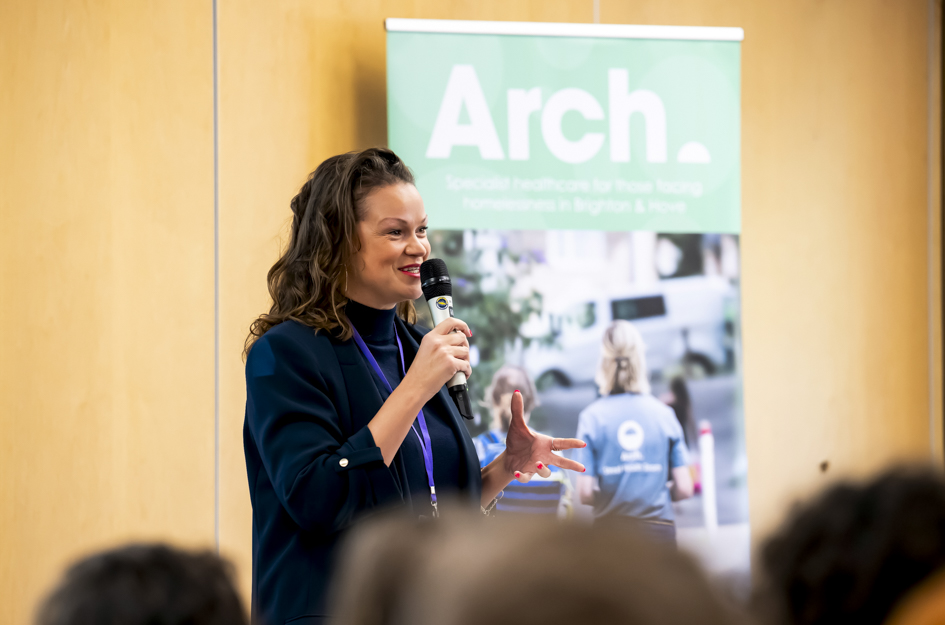
Photographing the Arch Healthcare CIC Annual Conference in Brighton
I’ve been covering the Arch Healthcare CIC annual conference for a couple of years now, and it’s become one of those jobs I genuinely look forward to, not because it’s easy, it really isn’t, but because it’s the kind of work that requires you to bring everything together at once: preparation, adaptability, discretion, and the sort of trust that only comes from working with the same organisation over time.
It sits within my broader charity and third sector photography work across Brighton and Sussex, and healthcare charity events have their own set of expectations because the images are not just being taken for one immediate purpose. They feed into annual reports, websites, social media, and future event promotion, all of which require slightly different visual approaches from the same set of moments.
Working from a flexible conference photography brief
With Arch, the brief has always been fairly loose in the best possible sense, usually a mix of delegates networking during breaks, speakers in the main auditorium, breakout sessions where possible, and staff around registration, with no expectation of formal group shots or overly staged moments because there simply isn’t the time or the need for them.
That’s actually very typical of conference photography, and in practice what matters far more than a detailed shot list is understanding why the images are being created and where they are going to be used afterwards.
With Arch, the conference feeds directly into the annual report as well as ongoing website and social content, so I’m always thinking in terms of how a wide establishing shot might carry a report spread, how a candid networking moment might work for donor communications, or how a speaker mid-gesture might sit within a longer narrative about the organisation’s work.
I’m essentially building a usable visual library across the entire day rather than shooting isolated moments.
Managing consent during healthcare conferences
One of the reasons this event works so well visually is because Arch uses a clear lanyard consent system, with red lanyards for delegates who do not want to be photographed and purple for those who have given consent.
In a healthcare setting where patient confidentiality and staff privacy carry real weight, that kind of structure removes ambiguity and allows the day to run smoothly for everyone.
In practice, working around that system is less about restriction and more about awareness, so it might mean adjusting an angle slightly, changing position so someone naturally falls out of frame, or simply waiting for the right moment in the flow of a room where people are moving, speaking or interacting.
If I notice someone turning away or appearing uncomfortable, I’ll adjust immediately, or if needed just reassure them that they won’t end up in the images, because that small bit of communication makes the whole environment more relaxed without ever interrupting the event itself.
Beyond the formal consent system, there’s the editing side of the process, which matters just as much. For something going into an annual report or a public-facing charity website, you are not just selecting good images. You are selecting images that represent people, patients, and the organisation appropriately.
Anything unflattering or unnecessary stays out. That’s part of why trust builds over time with returning clients in the third sector.
How I move through a conference day
A conference venue is rarely uniform, and you’re usually working across a main plenary space, smaller breakout rooms, and informal networking areas all within the same schedule, which means each part of the building requires a slightly different way of working.
For smaller breakout sessions, I’ll generally try to arrive before the session begins so I can find a position that gives me a clear angle without being intrusive, and I’ll also think quite carefully about how I’ll leave the space so I’m not moving through a quiet room at the wrong moment, which usually means waiting for natural pauses like questions, applause, or a change in speaker.
I always work in silent shooting mode, not because it is a stylistic choice, but because it simply removes a layer of disruption that doesn’t need to be there in environments where people are concentrating or discussing sensitive topics.
In the larger plenary rooms there is more flexibility, so I’ll often work between wide shots that show the scale of the audience, which are particularly useful for annual reports and sponsor visibility, and then move across the space to capture speakers from different angles, always watching for moments of expression rather than just continuously shooting.
The useful images are usually the ones where something is happening rather than just a static pose.
Why detail photographs matter
Alongside the main sessions, I always make sure to build in time for detail coverage because these are often the images that end up being surprisingly important for charity marketing and annual reporting purposes, whether that’s registration desks, badges, printed programmes, sponsor signage, or the general visual language of the event itself.
They may not be the headline images, but they are what make an event gallery feel complete and useful rather than just a collection of speaker photographs.
Why long term relationships improve charity photography
When you work with a charity or healthcare organisation repeatedly, the whole dynamic changes in a way that is hard to replicate on a first job.
You are no longer learning the basics of how they operate, what they value, or how they prefer to use their imagery.
By the time you return to a conference like this, you already understand the venue, the flow of the day, the team, and the informal expectations around how staff and delegates prefer to be photographed.
That familiarity helps people relax because they can see the environment is being handled consistently and with the discretion the setting requires.
Trust builds gradually, but once it is there it fundamentally changes the quality of the work you can produce.
Anja from Arch CIC described this after working with me on several photography projects:
“I’ve used Liz a number of times now for photography jobs at the Arch GP surgery and events we run and she’s always been excellent… she understands the brief each time, delivers plenty of high quality photos within a short turnaround time, and we’ve had lots of positive comments from staff, patients and event attendees.”
Planning photography for a charity conference
There are a few practical things that make a significant difference to how successfully a charity conference is covered, particularly when the output is going into annual reports or external donor communications.
Turnaround time needs to be realistic and agreed in advance, especially if images are feeding into an annual report or press cycle.
Usage should be clearly defined so there is no ambiguity about whether images are for internal reporting, donor communications, social media, or long-term marketing.
Timing and access are also more important than they might seem, because even a loose schedule helps shape coverage of key moments like registration, keynote sessions, or networking breaks.
And finally venue lighting is worth flagging early because some conference spaces are genuinely challenging to work in, particularly when you are moving between rooms with very different lighting conditions.
While that doesn’t prevent strong results, it does influence how the day is approached.
If you’re looking for a charity event photographer in Brighton or across Sussex, I’d be happy to discuss your requirements. Whether it’s an annual conference, a fundraising event, or something you run every year, get in touch here.